
The aging of critical infrastructure is consolidating as one of the main operational risks for industrial organizations worldwide. Energy networks, production facilities, logistics systems, and essential equipment are exceeding their expected lifecycles in a context of increasing regulatory pressure, demand for availability, and the need for operational efficiency.
In this scenario, aging management ceases to be a purely technical issue to become a strategic challenge that conditions service continuity, cost control, and the ability of organizations to operate with safety and predictability.
Critical Infrastructure: Why Asset Aging is a Strategic Crisis
In industrial, energy, logistics, or transport environments, operational continuity depends largely on the actual condition of the physical assets that support the activity. Facilities, equipment, and infrastructure that have guaranteed operation for years are progressively beginning to approach the end of their useful life.
This aging process does not respond to a specific event, but to a structural trend that affects multiple sectors simultaneously. Its impact transcends technical wear and tear and extends to safety, operating costs, regulatory compliance, and the ability of organizations to make decisions with reliable information.
When assets age without a clear strategy of visibility and control, what deteriorates is not only the equipment but the capacity for anticipation, planning, and resilience of the entire operation.
Asset Aging: A Silent Problem with Growing Impact
The deterioration of critical infrastructure rarely manifests abruptly. It usually appears as a progressive accumulation of minor incidents, increases in maintenance frequency, variations in expected performance, or extensions in repair times.
This gradual nature makes early detection difficult and favors its normalization within daily operations, until a significant breakdown reveals the real magnitude of the accumulated problem.
As assets exceed their expected lifecycle, organizations begin to experience:
- A sustained increase in unforeseen failures.
- Greater variability in intervention times.
- An escalation of costs associated with reactive maintenance.
- Growing dependence on undocumented technical knowledge.
- Greater exposure to safety risks and regulatory compliance issues.
In this context, aging ceases to be an exclusively technical issue to become a factor with a direct impact on results, service continuity, and corporate reputation.
From Physical Obsolescence to Lack of Operational Visibility
One of the most critical effects of aging is not the physical failure itself, but the progressive loss of visibility into the real state of the assets.
In many organizations, relevant information remains fragmented among unconnected systems, paper documentation, incomplete histories, or the tacit knowledge of certain professionals. This dispersion prevents building a reliable, updated, and shared operational view.
Without structured traceability, answering key questions becomes increasingly complex:
- Which assets concentrate the highest operational risk?
- What interventions have actually been performed?
- What failure patterns are emerging?
- Which investment decisions should be prioritized?
The direct consequence is a return to reactive management models, precisely at a time when operational complexity demands anticipation, planning, and control.
Critical Infrastructure Under Pressure: Safety, Compliance, and Continuity
The current regulatory framework intensifies this challenge. Sectors such as energy, transport, heavy industry, or facility management operate under growing demands regarding safety, traceability, auditing, and service availability.
Asset aging increases the difficulty of maintaining these standards without a solid base of operational information. Document consolidation becomes more complex, audits more demanding, and demonstrating compliance more costly and dependent on manual processes.
When the organization enters a permanent dynamic of incident resolution, the operational focus shifts from prevention to urgency. This transition reduces system resilience, increases risk exposure, and limits the capacity for adaptation in critical situations.
The Necessary Change: From Reactive Maintenance to Data-Driven Strategy
Facing this scenario, the most advanced organizations are evolving towards models where operational visibility becomes the central axis of asset management.
The change consists not only of increasing preventive maintenance but of transforming the relationship between the asset and the information that describes it. When every intervention is recorded, documentation is accessible in context, and history is fully traceable, decision-making ceases to depend on estimates and becomes based on real operational evidence.
Data-driven management allows you to:
- Anticipate failures before their operational impact.
- Prioritize investments according to risk and criticality.
- Reduce uncertainty in audits and compliance.
- Optimize maintenance planning and resources.
- Prolong the functional lifespan of infrastructure without compromising safety or availability.
At this point, aging ceases to be an unpredictable phenomenon and becomes integrated within a controlled operational strategy.
Digitizing Without Friction: The Real Challenge of Existing Infrastructure
Traditionally, modernizing asset management has implied complex projects, high technological dependence, and prolonged implementation times. This approach has hindered its adoption in environments where operational continuity limits any disruptive transformation.
The evolution of digital solutions today allows incorporating traceability, documentation, and operational control without replacing existing infrastructure or adding unnecessary complexity to daily operations.
This new paradigm enables decades-old infrastructure to acquire visibility capabilities typical of advanced digital environments, bridging the gap between historical operation and modern management and allowing progress towards more predictable, auditable, and sustainable maintenance models.
Digitization thus ceases to be a long-term goal to become an immediate tool for operational resilience.
Inevitably Aging, Optional Loss of Control
All infrastructure ages. No organization can avoid that process. What can be decided is whether that aging will occur in an environment of uncertainty or within a framework of control based on reliable information, operational traceability, and anticipation capacity.
Organizations that maintain reactive models will continue to face rising costs, greater risk exposure, and lower planning capacity. Conversely, those that adopt strategies based on visibility and data will be able to manage aging predictably, optimize the useful life of their assets, and reduce the probability of critical incidents.
In environments where service continuity is essential, this difference ceases to be operational to become a clearly strategic factor.
Preparing Tomorrow’s Resilience Today
The aging of critical infrastructure is no longer a future scenario, but a present reality that demands new capabilities for management, control, and decision-making.
Developing operational resilience implies having continuous visibility into the real state of assets, recording their behavior over time, anticipating their evolution, and acting based on verifiable information.
In this context, the digitization of asset management becomes a key enabler to transform reactive maintenance into structured preventive maintenance, reduce dependence on manual processes, and ensure the traceability necessary to operate with safety and compliance.
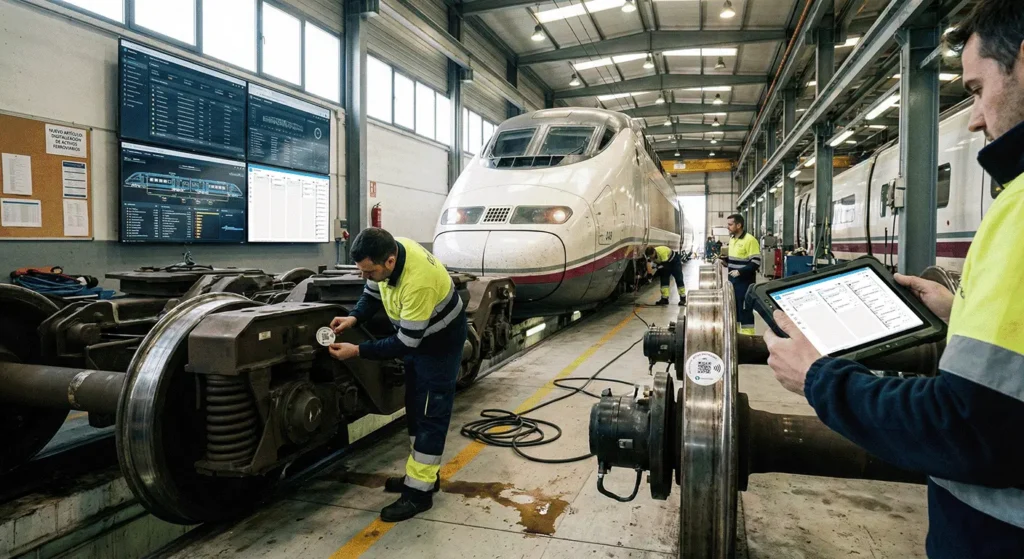
Solutions like TicTAP allow moving in this direction progressively and without operational friction, facilitating access to asset information directly from the field, simplifying the execution of preventive maintenance, and providing continuous visibility into the status of distributed infrastructure.
This approach not only contributes to reducing incidents and optimizing costs, but allows maintaining control over aging assets and prolonging their operational lifespan without compromising safety or service availability.
Because, ultimately, operational resilience does not depend solely on the age of the infrastructure, but on the organization’s ability to manage it with visibility, traceability, and long-term preventive criteria.
Conclusion
The aging of assets in critical infrastructure represents one of the main operational challenges of the next decade, with a direct impact on safety, costs, regulatory compliance, and service continuity.
Facing it effectively requires evolving from reactive models towards strategies based on data, visibility, and structured preventive maintenance. Only in this way is it possible to transform a structural risk into a manageable element within strategic planning.
Organizations that advance in this direction will not only reduce incidents and costs but will reinforce their resilience, their adaptability, and their preparedness for an increasingly demanding operational environment.
In this scenario, moving towards management models with greater visibility and control is no longer an improvement option, but a necessary condition to guarantee long-term operational continuity.