
In many industrial organizations, maintenance digitalization does not advance at the same pace as operational complexity. While some plants continue to manage interventions with tools focused solely on work orders, others need a broader view that allows understanding the complete behavior of their assets, their real costs, and their impact on operational continuity.
This maturity gap explains why the decision between EAM and CMMS has become one of the most relevant technological choices for maintenance managers, CIOs, and digital transformation teams. Choosing correctly not only affects daily maintenance efficiency but also the company’s ability to scale its operating model, reduce risks, and optimize investments throughout the asset lifecycle.
Understanding this decision requires going beyond a functional comparison. It implies analyzing operational coverage, management depth, scalability, and alignment with business strategy.
Functional differences between EAM and CMMS in operational practice
A CMMS is designed to structure maintenance execution. It allows planning interventions, recording work orders, managing spare parts inventory, and keeping a technical history of equipment. Its main contribution consists of organizing daily operations and reducing dependence on reactive maintenance, providing a minimum basis of traceability.
However, when the organization needs to understand how much each asset really costs, how its reliability evolves, or when it is advisable to replace it, the scope of the CMMS begins to be limited. That is where the EAM approach appears.
EAM extends maintenance management towards comprehensive asset lifecycle management. It integrates technical, economic, and operational information into a single environment that allows analyzing accumulated costs, evaluating risks, planning renewals, and aligning technical decisions with financial and strategic objectives. This difference transforms maintenance from an operational function into a business management element.
Coverage, scale, and growth capacity
The comparison between maintenance software cannot be separated from the organizational context. The CMMS usually fits in environments with moderate complexity, where the main challenge is to organize processes, improve basic traceability, and reduce operational incidents. Its implementation is fast and its adoption simple for teams starting their digitalization.
EAM, on the other hand, responds to scenarios where assets are critical, regulation is demanding, or operational scale requires a transversal view. Its ability to integrate multiple plants, connect corporate areas, and sustain long-term decisions makes it a platform oriented towards growth and operational sustainability.
Comparative Table EAM vs CMMS
| Aspect | CMMS | EAM |
|---|---|---|
| Main focus | Operational maintenance management | Comprehensive asset lifecycle management |
| Cost visibility | Limited to interventions | Complete throughout the lifespan |
| Planning level | Short and medium term | Strategic and financial |
| Scalability | Medium | High, multi-plant and corporate |
| Business integration | Reduced | Broad with corporate systems |
| Impact on decisions | Operational | Strategic |
This comparison shows that the key difference does not lie in isolated functionalities, but in the type of decisions that each system allows making.
Decision matrix: when to choose CMMS and when EAM
Choosing between both systems requires analyzing the real impact of assets on the operation, the level of economic control needed, and the organization’s growth projection. When the priority is to organize maintenance, reduce unexpected breakdowns, and have basic traceability, the CMMS offers quick results with less implementation complexity.
However, when business continuity depends on critical assets, lifecycle costs acquire strategic relevance, and the organization needs to make decisions based on integrated data, the EAM approach becomes the natural step. In practice, many companies evolve progressively from CMMS towards EAM as their operational maturity increases.
The role of digitalization in modern asset management
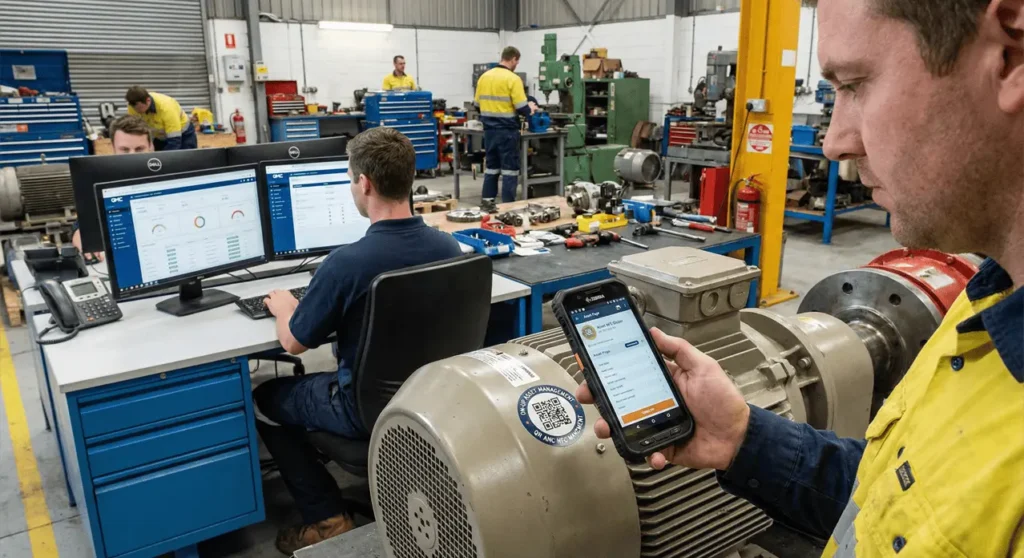
Beyond the specific technology, the real change occurs when asset information is accessible in real time, traceable, and connected with the operation. Digitalization allows recording what happens in the field, understanding the real behavior of equipment, and transforming maintenance into a continuous process of operational improvement.
This basis is essential to advance from reactive models towards preventive, predictive, and finally strategic approaches.
Conclusion: how TicTAP drives the evolution towards advanced asset management
The choice between EAM and CMMS should not be posed solely as a software decision, but as a step within the company’s operational evolution. Organizations that manage to connect traceability, real-time information, and asset lifecycle control achieve reduced uncertainty, optimized resources, and improved productive continuity.
In this context, TicTAP allows making that leap progressively, facilitating digital asset identification, immediate access to technical information, and complete traceability of interventions from the point of work itself. This visibility connects daily operations with strategic decision-making, bringing organizations closer to a management model aligned with EAM principles without introducing unnecessary complexity.
If you want to delve deeper into how to digitalize your asset traceability and improve industrial maintenance control, you can discover more about our platform here:
You can also contact our team to analyze your specific case and define the most suitable path towards more efficient and connected asset management: